Best AI Chatbot for Business Websites: A Complete Guide (2026)
Customers expect businesses to respond quickly, whether they are asking about a product, checking service availability, requesting pricing information or looking for technical support.
However, providing instant customer support around the clock can be challenging, especially for small businesses and growing companies with limited support teams.
This is where an AI chatbot for business websites can make a significant difference.
Modern AI chatbots can understand customer questions, provide relevant answers, recommend products, collect leads and automate common support conversations. Unlike traditional rule-based chatbots, AI-powered assistants can use business information and knowledge sources to provide more natural and context-aware responses.
Whether you operate an ecommerce store, professional services company, SaaS platform or corporate website, an AI chatbot can help improve customer communication and reduce repetitive support tasks.
In this guide, we explore how AI chatbots work, their benefits, essential features to consider and how businesses can use AI-powered customer support to improve their online operations.
What Is an AI Chatbot for Business Websites?
An AI chatbot is a software application that uses artificial intelligence and natural language processing to communicate with website visitors through automated conversations.
Instead of navigating multiple pages or waiting for a support representative, visitors can simply type their questions into a chat interface and receive relevant responses.
Depending on its configuration and integrations, an AI chatbot can help customers:
Find information about products and services
Understand pricing and business policies
Get answers to frequently asked questions
Explore product recommendations
Submit enquiries and contact details
Receive basic technical support
Navigate website content
Connect with a human support representative
Modern AI chat agents can also be trained using business-specific information, allowing them to respond based on a company's products, services, documentation and policies.
Why Do Businesses Need AI Chatbots in 2026?
Customer expectations have changed. People increasingly expect quick answers without waiting for business hours or sending multiple emails.
An AI chatbot can help businesses improve communication while reducing the workload associated with repetitive enquiries.
Here are some important benefits.
1. Provide 24/7 Customer Support
One of the biggest advantages of AI chatbots is their ability to handle conversations outside normal business hours.
Customers visiting a website late at night, during weekends or in different time zones can still receive automated assistance.
This is especially useful for businesses serving international customers.
2. Respond to Customer Questions Faster
Customers frequently ask similar questions about pricing, services, delivery, product availability and business policies.
An AI chatbot can answer many common enquiries automatically using its configured knowledge base.
This reduces the need for customers to wait for an employee to respond to every basic question.
3. Generate More Business Leads
An AI chatbot can do more than answer questions.
It can guide visitors through conversations and collect relevant information from potential customers.
For example, a website visitor looking for web development services may be asked about:
Their business type
Required services
Project requirements
Estimated budget
Contact information
This information can help businesses identify potential customers and follow up with relevant enquiries.
4. Reduce Repetitive Support Work
Customer support teams often spend significant time answering the same questions repeatedly.
AI automation can handle common enquiries and provide instant information, allowing human representatives to focus on complex requests that require personal attention.
5. Improve Customer Experience
A well-configured AI chatbot can make it easier for website visitors to find information.
Instead of searching through multiple pages, customers can ask direct questions and receive relevant answers.
The result can be a more convenient website experience.
How Does an AI Chatbot Learn About Your Business?
One of the most important features of a modern AI chatbot is its ability to use business-specific information.
A general-purpose chatbot may not know the details of your products, pricing, policies or services.
AI chatbot training helps solve this problem by providing relevant information that the assistant can use when responding to customers.
Common training methods include:
1. Website URL Training
Businesses can provide their website URL as a knowledge source.
The AI training system can process available website content and use that information to answer customer questions.
For example, an ecommerce company can train its chatbot using its website's product and information pages.
Customers can then ask questions about products, services and other available information.
2. PDF Document Training
Businesses often maintain important information in PDF documents, including:
Product catalogues
Company profiles
Service brochures
User manuals
Policy documents
Frequently asked questions
A chatbot with PDF training capabilities can use supported documents as knowledge sources.
This makes it easier for businesses to provide detailed information without manually adding every answer to a separate FAQ list.
3. Business Knowledge Base
A knowledge base provides a structured collection of business information that an AI assistant can reference.
It may include product details, service descriptions, pricing information, policies, procedures and frequently asked questions.
Maintaining an accurate knowledge base helps improve the relevance and consistency of chatbot responses.
It is also important to review training information regularly so the chatbot does not provide outdated prices, policies or product details.
Essential Features to Look for in AI Chatbot Software
Not every chatbot platform provides the same capabilities. Businesses should evaluate the following features before choosing an AI chatbot solution.
1. Website Chat Widget
A website chatbot should be easy to install and customise.
Look for a platform that provides a responsive chat widget that can be added to your website without complicated development work.
Customisation options may include:
Brand colours
Company logo
Welcome messages
Chat window appearance
Positioning
Mobile responsiveness
2. AI-Powered Responses
The chatbot should understand natural-language questions rather than relying entirely on predefined buttons and fixed conversation paths.
An AI-powered assistant can interpret different ways of asking the same question and provide responses based on available business information.
Response accuracy still depends on the underlying AI model, instructions and quality of the knowledge sources.
3. Website and PDF Training
Choose software that allows you to provide business information through different knowledge sources.
Website URL and PDF training can be particularly useful for companies with extensive documentation or multiple service pages.
4. WooCommerce Integration
For ecommerce businesses, WooCommerce integration can make an AI chatbot more useful.
Depending on the integration, an AI assistant may help customers:
Find relevant products
Answer product-related questions
Provide product information
Guide customers through shopping decisions
Assist with common store enquiries
More advanced integrations may support additional store-related actions, depending on the permissions and capabilities provided by the platform.
5. WhatsApp AI Automation
WhatsApp is an important customer communication channel for many businesses.
A WhatsApp-connected AI chatbot can help automate conversations, answer common enquiries and support customer communication.
Depending on the integration, businesses may be able to connect their AI assistant with WhatsApp Business Platform capabilities.
Before choosing a solution, check whether it supports the official WhatsApp integration, applicable messaging rules and any required API setup.
6. Lead Collection
An AI chatbot should help businesses turn website conversations into useful enquiries.
Lead collection capabilities can include:
Customer name
Email address
Phone number
Business requirements
Product interests
Service enquiries
This information can be used by the sales team for appropriate follow-up.
7. Human Handoff
AI should not be expected to handle every customer situation.
Some enquiries require human judgement, technical assistance or personalised support.
A useful chatbot platform should provide a way to transfer conversations to a human representative when necessary.
8. Conversation Analytics
Analytics help businesses understand how customers interact with their AI assistant.
Useful information may include:
Total conversations
Common customer questions
Lead enquiries
Unanswered questions
Chat activity
Customer engagement
These insights can help businesses improve their chatbot training and customer support processes.
AI Chatbots vs Traditional Rule-Based Chatbots
Traditional chatbots generally follow predefined rules and conversation paths.
For example, a visitor may need to select a button such as Products, Pricing or Contact before receiving information.
AI chatbots use language models and configured knowledge sources to understand a wider variety of questions.
| Feature | Traditional Chatbot | AI Chatbot |
|---|---|---|
| Predefined responses | Yes | Optional |
| Natural-language questions | Limited | Supported |
| Website knowledge training | Usually limited | Available on supported platforms |
| PDF knowledge sources | Usually limited | Available on supported platforms |
| Complex questions | Limited | More flexible |
| Product assistance | Rule-based | AI-assisted |
| Lead collection | Yes | Yes |
| Human handoff | Platform dependent | Platform dependent |
AI chatbots are generally more flexible, but they still require proper configuration, reliable knowledge sources and monitoring.
How Businesses Can Use AI Chatbots
AI chatbots are useful across many industries and business models.
Ecommerce Stores: Help customers discover products, understand product details and find answers to common shopping questions.
SaaS Companies: Answer questions about software features, subscriptions, onboarding and technical documentation.
Web Development Agencies: Explain services, collect project requirements and qualify potential clients.
Educational Institutions: Answer common questions about programmes, admissions and available courses.
Real Estate Businesses: Provide information about properties, services and customer enquiries.
Healthcare Websites: Handle general administrative enquiries, such as appointment information and clinic services, while leaving medical advice to qualified professionals.
Professional Services: Help visitors understand service offerings, pricing information and consultation processes.
How to Choose the Right AI Chatbot for Your Business
Before investing in an AI chatbot platform, consider these important factors:
Training capabilities: Check whether you can train the chatbot using website URLs, PDFs and other supported knowledge sources.
Response quality: Test how accurately the chatbot answers questions about your actual business.
Integration options: Check support for WooCommerce, WhatsApp and other platforms relevant to your operations.
Customisation: Make sure the chat widget can match your website branding.
Lead generation: Look for tools that can collect and organise customer enquiries.
Human support: Check whether conversations can be transferred to your team.
Analytics: Review available reporting and conversation insights.
Security: Understand how customer conversations and uploaded business documents are stored and protected.
Pricing: Compare subscription limits, AI usage allowances, integrations and available features.
The best AI chatbot is not necessarily the one with the longest feature list. It is the one that provides useful, accurate assistance for your customers and fits your business workflow.
Introducing Digixo AI Chat Agent – Smart 24/7 Customer Support
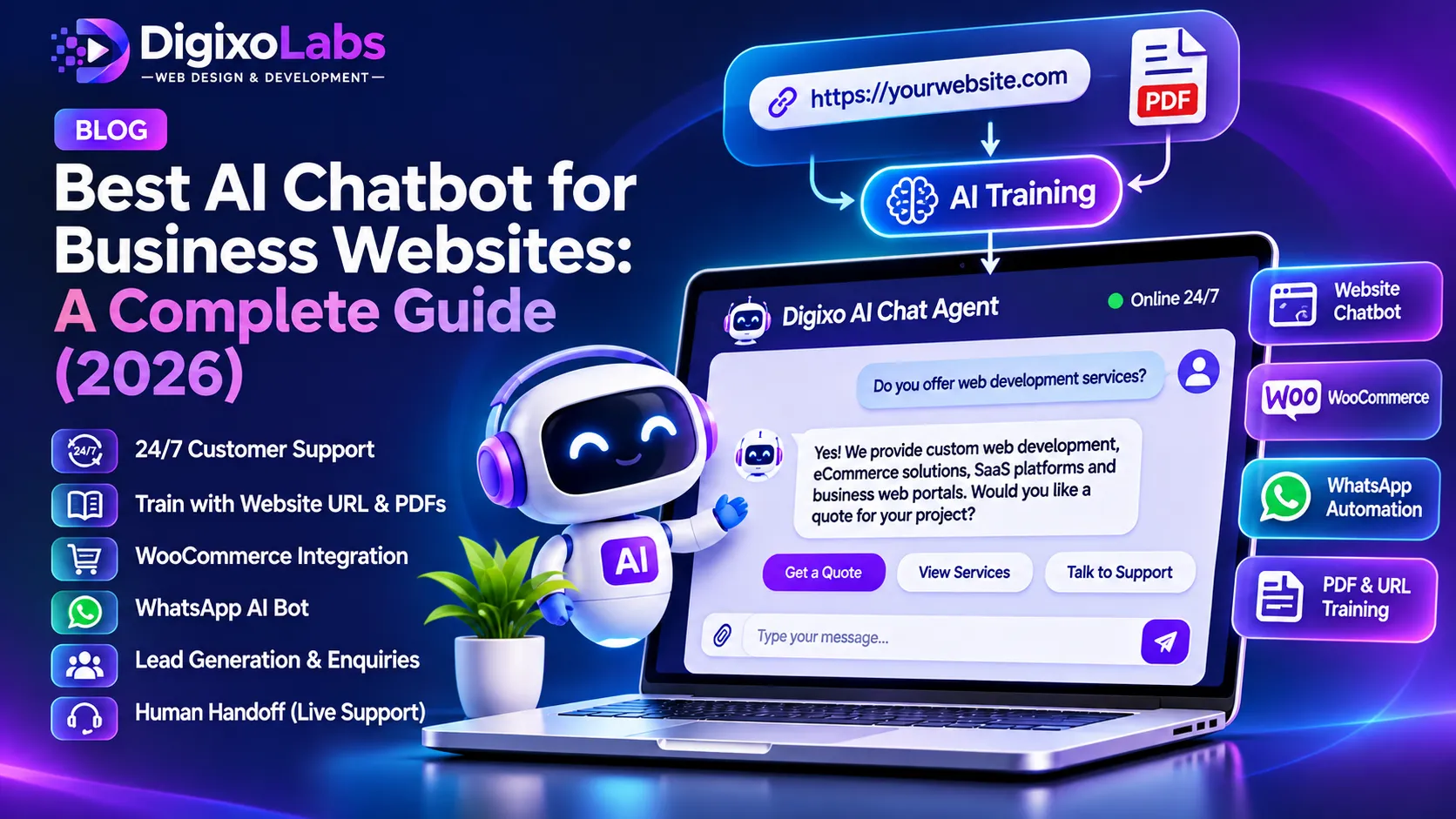
Digixo AI Chat Agent is part of the Digixo Labs cloud software suite, designed to help businesses automate customer conversations and provide AI-powered assistance through their digital channels.
Instead of relying entirely on manual customer support, businesses can configure an AI assistant using their own website information and supported knowledge sources.
Digixo AI Chat Agent brings together capabilities designed for modern business communication, including:
AI-powered website chat assistant
Website URL training
PDF document training
Business knowledge base
Customisable chat widget
WooCommerce integration
WhatsApp chatbot automation
Lead collection
Customer conversation management
Human handoff and support workflows
The platform is designed to help businesses provide information, answer customer questions and manage enquiries more efficiently.
Whether you operate an online store, SaaS business, service company or professional agency, Digixo AI Chat Agent can help you introduce AI-powered customer communication into your business.
Explore Digixo AI Chat Agent:
https://digixolabs.com/ai-chat-agent
Final Thoughts
Customer communication plays an important role in business growth. However, answering every enquiry manually can become difficult as website traffic and customer expectations increase.
Modern AI chatbots provide businesses with a way to automate common conversations, answer questions using business-specific information and collect potential customer enquiries.
With capabilities such as website training, PDF knowledge sources, WooCommerce integration and WhatsApp automation, AI chat agents can become a valuable part of a company's customer support strategy.
If you want to improve customer communication and reduce repetitive support tasks, consider introducing an AI chatbot to your website.
Discover Digixo AI Chat Agent by Digixo Labs and explore a smarter approach to automated customer support.