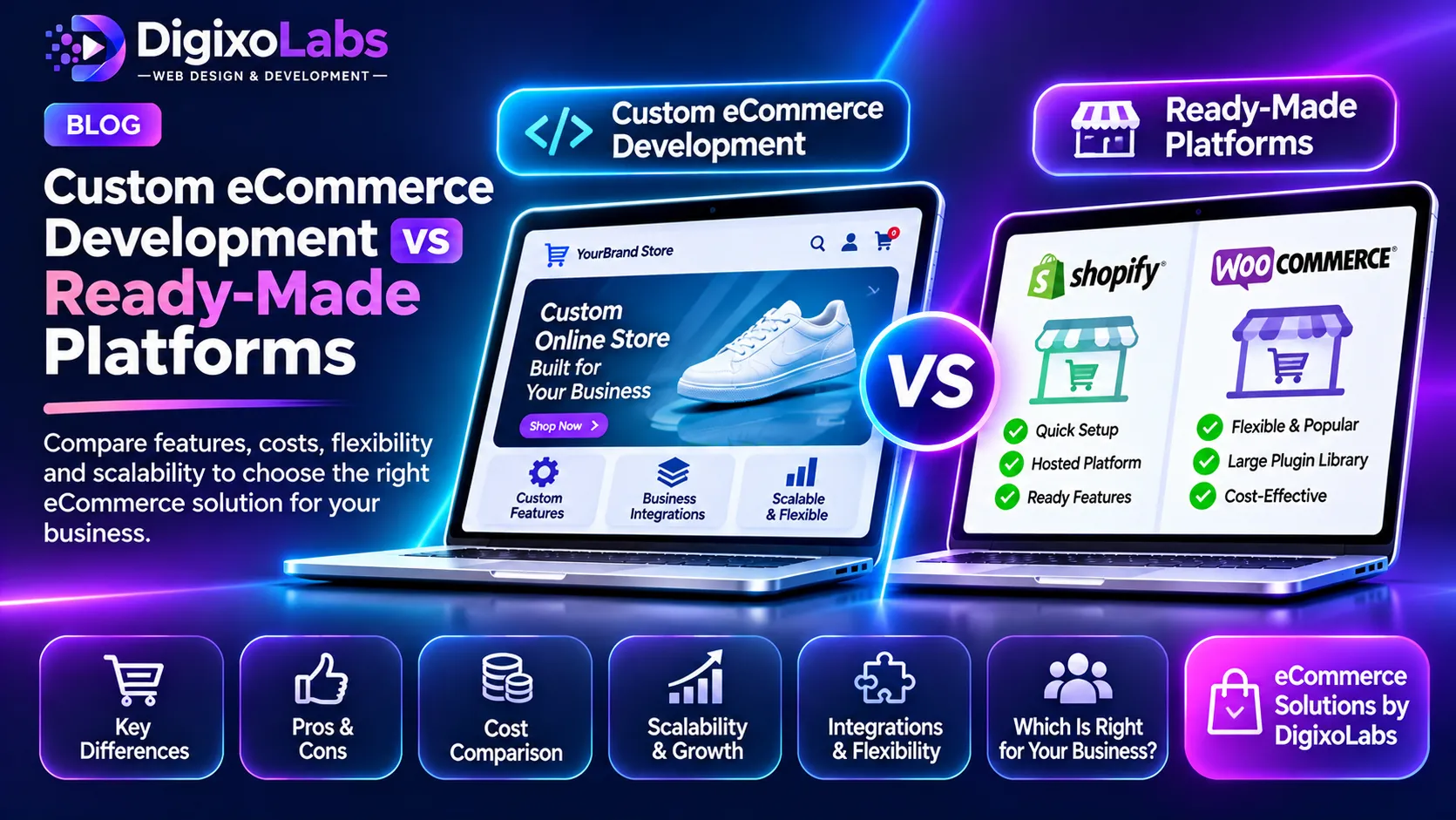
Custom eCommerce Development vs Ready-Made Platforms: Which Is Better for Your Business?
Starting an online store has become easier than ever. Businesses can now launch an eCommerce website using ready-made platforms such as Shopify, WooCommerce and other online store builders.
However, as an online business grows, its requirements often become more complicated.
Some businesses need advanced product management, customised checkout processes, dealer pricing, wholesale ordering, inventory synchronisation and integrations with existing business systems.
This raises an important question: Should you choose a ready-made eCommerce platform or invest in custom eCommerce development?
Both approaches have advantages, and the right choice depends on your business model, budget, technical requirements and long-term goals.
In this guide, we compare custom eCommerce development with ready-made platforms, explore their advantages and disadvantages, and explain how to choose the right solution for your business.
What Is a Ready-Made eCommerce Platform?
A ready-made eCommerce platform is a pre-developed system that allows businesses to create and manage online stores without building everything from scratch.
These platforms provide standard features such as product catalogues, shopping carts, checkout systems, payment integrations and order management.
Popular examples include:
Shopify: A hosted eCommerce platform designed to help businesses launch and manage online stores.
WooCommerce: A flexible eCommerce plugin built for WordPress websites.
PrestaShop: An open-source eCommerce platform with product and store management functionality.
OpenCart: An open-source platform for managing online shops.
These solutions provide a foundation for launching an online business.
Instead of developing every feature independently, you can use existing functionality and customise the store according to your requirements.
Advantages of Ready-Made Platforms
Ready-made platforms can be an excellent starting point for many businesses.
1. Faster Store Launch
Most essential eCommerce features are already available, allowing businesses to launch their online stores relatively quickly.
2. Lower Initial Development Cost
You do not need to develop a complete shopping cart, product management system or checkout process from scratch.
3. Existing Integrations
Many platforms support integrations with payment gateways, shipping providers, marketing tools and accounting applications.
4. Themes and Extensions
Businesses can customise their store using available themes, plugins and extensions.
5. Established Ecosystems
Popular platforms have large communities, documentation and third-party developers who can provide support and additional functionality.
Limitations of Ready-Made Platforms
Although ready-made platforms are convenient, they may not be suitable for every business.
Some common limitations include:
Restrictions in certain checkout and ordering workflows.
Dependence on third-party plugins and extensions.
Additional subscription or transaction-related costs, depending on the platform and payment setup.
Limited control over the underlying application architecture.
Compatibility issues between plugins.
Difficulty implementing highly specialised business processes.
Dependence on the platform provider's policies and technical limitations.
These limitations do not affect every business, but they can become important when an online store requires specialised functionality.
What Is Custom eCommerce Development?
Custom eCommerce development involves building an online store specifically around your business requirements.
Instead of relying entirely on a ready-made platform, developers create the required features, database structure, administration panel and customer experience.
A custom eCommerce solution can include:
Custom product catalogues.
Advanced product filtering.
Personalised shopping carts.
Custom checkout workflows.
Dealer and wholesale pricing.
Customer-specific discounts.
Multi-vendor functionality.
Inventory management.
Order processing.
Custom payment integrations.
Shipping and delivery integrations.
Business reporting dashboards.
API integrations.
For example, a wholesale distributor may need a portal where registered dealers can log in, view their personalised product prices, place bulk orders and download invoices.
A standard online store may not provide this exact workflow without significant customisation.
A custom-built solution allows the business to develop functionality around its actual operations.
Custom eCommerce vs Ready-Made Platforms: Key Differences
Let's compare both approaches across important business and technical factors.
| Feature | Ready-Made Platform | Custom eCommerce |
|---|---|---|
| Initial setup | Usually faster | Requires development |
| Initial cost | Often lower | Depends on complexity |
| Design flexibility | Theme and customisation dependent | Highly flexible |
| Features | Standard platform features | Built around requirements |
| Checkout | Platform-dependent | Customisable |
| Integrations | Available extensions and APIs | Custom integrations possible |
| Database structure | Platform-defined | Can be designed for the project |
| Maintenance | Platform or store owner responsibility | Requires an agreed maintenance plan |
| Scalability | Depends on platform and plan | Depends on architecture and infrastructure |
| Source code control | Platform-dependent | Depends on ownership agreement |
| Business workflows | Standard or extension-based | Can be tailored |
The important difference is flexibility.
Ready-made platforms provide existing functionality, while custom development allows businesses to build specialised functionality according to their requirements.
10 Important Reasons to Consider Custom eCommerce Development
If your business has requirements beyond a standard online shop, custom development may offer several advantages.
1. Complete Control Over Store Design
Your online store represents your brand.
With custom eCommerce development, you can create a unique shopping experience instead of relying on predefined themes.
You can customise:
Homepage layouts.
Product pages.
Category pages.
Shopping cart design.
Checkout experience.
Customer dashboards.
Mobile shopping interfaces.
This gives your business greater design flexibility and allows you to create an experience that reflects your brand identity.
2. Custom Product Management
Different businesses sell different types of products.
A clothing store may require size and colour variations, while an electronics distributor may need technical specifications, product compatibility and warranty information.
A custom system can be designed to support specific product structures and management requirements.
For example:
Product variations.
Custom attributes.
Product bundles.
Wholesale product pricing.
Bulk product imports.
Special product categories.
Custom stock management.
3. Advanced Wholesale and Dealer Ordering
Wholesale businesses often have different requirements from ordinary retail stores.
They may need registered dealers, customer-specific pricing, minimum order quantities and bulk ordering functionality.
A custom eCommerce application can provide:
Dealer registration and approval.
Individual dealer accounts.
Special pricing for each customer.
Minimum order quantities.
Bulk order forms.
Credit limits where required.
Dealer order history.
Dedicated business dashboards.
This makes custom development particularly useful for B2B eCommerce businesses.
4. Custom Checkout and Payment Workflows
The checkout process is one of the most important parts of an online store.
Different businesses may require different payment and ordering methods.
For example:
Cash on Delivery (COD).
Bank transfer.
Online payment gateways.
Advance payments.
Partial payments.
Wholesale payment arrangements.
Customer-specific payment terms.
A custom solution can be developed around supported payment providers and the business's specific requirements.
5. Better Integration With Business Systems
An online store often needs to communicate with other applications.
For example, an eCommerce business may use separate software for inventory, accounting, customer management and shipping.
Custom development can help connect these systems through APIs.
Possible integrations include:
Accounting software.
CRM systems.
Inventory management applications.
Payment gateways.
Shipping and courier services.
WhatsApp notifications.
ERP systems.
External product databases.
This can reduce manual work and improve data consistency across business operations.
6. Custom Customer Dashboards
A standard customer account may provide basic order history and profile management.
However, some businesses need more advanced customer portals.
A custom dashboard can allow customers to:
View previous orders.
Download invoices.
Track deliveries.
Manage saved addresses.
Submit support requests.
Request quotations.
View outstanding balances.
Manage subscriptions where supported.
These features can improve customer convenience and reduce administrative work.
7. Greater Flexibility for Business Growth
Your business requirements may change over time.
You might begin with a simple online shop and later introduce wholesale ordering, multiple warehouses, customer-specific pricing or additional sales channels.
A well-planned custom application can be expanded as your requirements evolve.
However, scalability depends on the quality of the application architecture, database design, hosting infrastructure and development practices.
8. Custom Administration Panel
Managing an online store should be straightforward.
A custom administration panel can bring important business activities together in one place.
Possible modules include:
Product management.
Customer management.
Order management.
Inventory management.
Discount management.
Shipping configuration.
Sales reports.
User permissions.
Store settings.
You can also create different administrative roles for employees and managers.
9. Greater Control Over Application Architecture
With a custom-built solution, the application architecture can be planned according to your business requirements.
This may include custom database tables, specific application modules, dedicated APIs and specialised integrations.
It also gives you the opportunity to choose an appropriate technology stack and hosting environment.
Source code ownership and control should always be clarified in the development agreement.
10. Build a Platform Around Your Business Model
Some businesses have unique operating models that cannot easily fit into standard online store functionality.
For example:
Wholesale marketplaces.
Subscription-based product stores.
B2B ordering portals.
Multi-vendor marketplaces.
Custom product configuration platforms.
Distributor and dealer networks.
Custom development allows you to build the application around the business model instead of changing your business processes to fit a generic platform.
Shopify vs WooCommerce vs Custom eCommerce Development
Two of the most popular options for starting an online store are Shopify and WooCommerce.
Let's understand where each option fits.
Shopify
Shopify is a hosted eCommerce platform that provides store management, product catalogues, checkout functionality and an ecosystem of apps.
Best suited for:
Businesses wanting a managed online store.
Entrepreneurs launching new eCommerce brands.
Retail businesses with standard selling requirements.
Companies that prefer a hosted platform.
Its main advantage is convenience. Hosting and much of the underlying platform infrastructure are managed by Shopify.
However, businesses should consider subscription fees, app costs, platform policies and available customisation options.
WooCommerce
WooCommerce is an open-source eCommerce plugin for WordPress.
It allows businesses to convert a WordPress website into an online store.
Best suited for:
WordPress-based businesses.
Small and medium-sized online shops.
Businesses wanting control over their WordPress hosting.
Stores requiring a combination of content marketing and eCommerce.
WooCommerce supports extensive customisation through themes, plugins and development.
However, businesses are responsible for managing hosting, updates, backups, security and plugin compatibility, unless these responsibilities are handled by a service provider.
Custom eCommerce Development
Custom eCommerce development is suitable for businesses that need specialised functionality or greater control over their application.
Best suited for:
Wholesale distributors.
B2B businesses.
Companies with complex pricing structures.
Businesses requiring specialised integrations.
Companies developing their own eCommerce platforms.
Organisations with unique operational workflows.
Custom development generally requires more planning and development work, but it provides greater flexibility to implement business-specific functionality.
How Much Does Custom eCommerce Development Cost?
The cost of developing a custom online store depends on its features, complexity and technical requirements.
A basic online store with product management and checkout functionality will require less development than a complete B2B platform with multiple user roles, dealer pricing, inventory synchronisation and API integrations.
Important cost factors include:
Design requirements: Custom layouts, responsive interfaces and user experience design.
Product management: Product variations, attributes, categories and bulk imports.
Shopping functionality: Cart, checkout, discounts and order processing.
Payment integrations: Supported payment gateways and transaction workflows.
Administration panel: Product, customer, order and inventory management.
Third-party integrations: Accounting, shipping, CRM and other external systems.
Security and testing: Authentication, payment security, validation and application testing.
Hosting and maintenance: Server resources, backups, monitoring and ongoing updates.
For businesses with a limited budget, a phased development approach can be useful.
Start with the essential store functionality and introduce advanced features as your business grows.
Which eCommerce Solution Should You Choose?
There is no single solution that is best for every business.
The right choice depends on your requirements.
Choose Shopify if:
You want to launch quickly.
You prefer managed hosting.
Your business follows standard retail workflows.
You want an established eCommerce ecosystem.
Choose WooCommerce if:
Your website already uses WordPress.
You want flexibility through plugins and custom development.
You prefer managing your own hosting environment.
You need content marketing and eCommerce together.
Choose Custom eCommerce Development if:
You need specialised business functionality.
You operate a wholesale or dealer network.
You require customer-specific pricing.
You need advanced business integrations.
You want a platform built around your own workflows.
Your business requires greater control over application architecture.
Before making a decision, list your essential features, expected order volume, integrations, budget and future requirements.
This will help you choose a solution that fits your business rather than investing in unnecessary functionality.
Custom eCommerce Development Services by DigixoLabs
At DigixoLabs, we help businesses develop professional eCommerce websites and custom online platforms.
Our approach focuses on understanding your business requirements and recommending the right technical solution.
Whether you need a standard online shop, a customised WooCommerce store or a completely custom-built eCommerce application, we can help.
Our eCommerce development services include:
Custom eCommerce website development.
WooCommerce store development.
Shopify store setup and customisation.
Custom product catalogues.
Shopping cart and checkout development.
B2B and wholesale ordering portals.
Dealer and distributor management.
Cash on Delivery (COD) integrations.
Payment gateway integrations.
Courier and shipping integrations.
Custom administration dashboards.
API and third-party integrations.
We focus on building practical, responsive and business-oriented eCommerce solutions.
Ready to build your online store?
Let's discuss your business requirements and find the right eCommerce solution.
Explore our eCommerce Solutions:
https://digixolabs.com/ecommerce-solutions
Frequently Asked Questions (FAQs)
1. What is custom eCommerce development?
Custom eCommerce development is the process of building an online store according to specific business requirements. It can include customised product management, checkout workflows, dashboards, integrations and specialised ordering functionality.
2. Is custom eCommerce better than Shopify?
Custom eCommerce is not automatically better than Shopify. Shopify is suitable for businesses that need a managed platform with standard online selling features. Custom development is more suitable when specialised functionality, workflows or integrations are required.
3. Is WooCommerce suitable for large eCommerce businesses?
Yes. WooCommerce can support large online stores when properly configured and hosted. Performance depends on factors such as hosting resources, database optimisation, plugins, traffic and application architecture.
4. How much does custom eCommerce development cost?
Costs depend on the project's complexity, design, features, integrations and development requirements. A simple custom store will generally cost less than a complete B2B eCommerce platform.
5. Can I migrate my Shopify store to a custom eCommerce platform?
Yes. Products, customer information, order records and other data may be migrated, depending on the source platform's export options, available APIs and data structure. Proper migration planning is important to preserve data accuracy and SEO.
6. Can a custom eCommerce website support Cash on Delivery?
Yes. Custom eCommerce applications can support Cash on Delivery workflows, including order confirmation, delivery status tracking and courier integrations where supported.
7. Can I create a wholesale eCommerce website?
Yes. A custom wholesale platform can include dealer registration, customer-specific pricing, bulk ordering, minimum quantities, quotation requests and dedicated customer dashboards.
8. Is custom eCommerce development suitable for small businesses?
It can be, especially when a small business has specialised requirements. However, businesses with standard selling needs may find Shopify or WooCommerce more cost-effective initially.
9. Can custom eCommerce websites integrate with accounting and inventory software?
Yes. Custom applications can integrate with compatible accounting and inventory systems through APIs or other supported integration methods.
10. Does DigixoLabs provide custom eCommerce development?
Yes. DigixoLabs provides eCommerce development services, including custom online stores, WooCommerce solutions, Shopify customisation, B2B portals and business-specific eCommerce applications.
Conclusion
Choosing between custom eCommerce development and a ready-made platform is an important decision for any online business.
Ready-made platforms such as Shopify and WooCommerce provide convenient ways to launch an online store with established functionality.
Custom eCommerce development offers greater flexibility for businesses with specialised workflows, advanced integrations and unique operational requirements.
The best solution is the one that supports your current business needs while allowing you to grow without unnecessary technical limitations.
Whether you are launching a new online store or upgrading an existing eCommerce platform, choosing the right development approach can make a significant difference.
Build an eCommerce platform that works for your business with DigixoLabs.