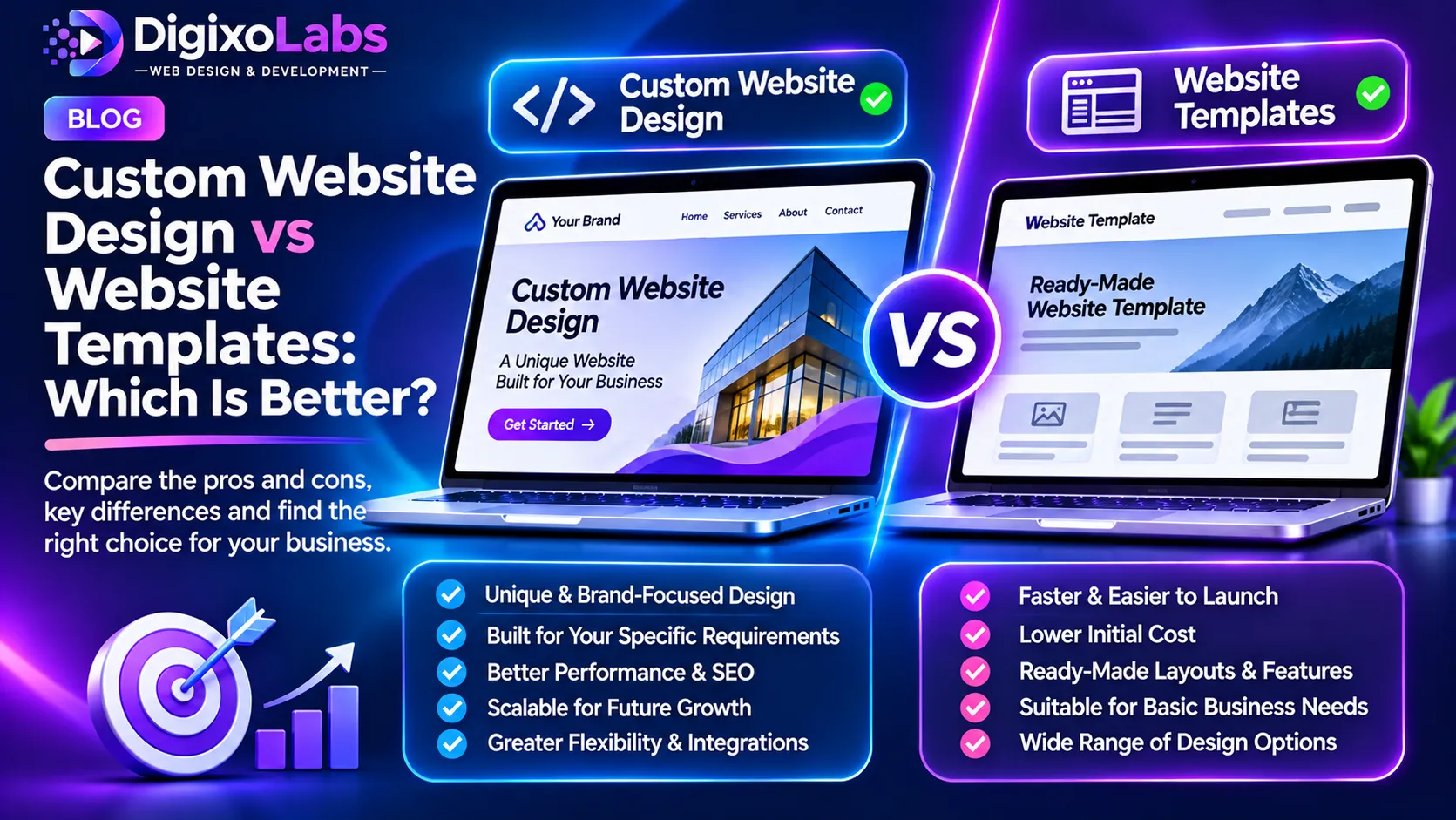
Custom Website Design vs Website Templates: Which Is Better?
A professional website is one of the most important investments a business can make. It represents your brand, introduces your services, builds customer trust and helps generate new business opportunities.
However, when planning a new website, businesses often face an important decision: Should you choose a ready-made website template or invest in custom website design?
Both options can help you establish an online presence, but they offer different levels of flexibility, functionality, design control and long-term value.
Website templates provide a convenient way to launch a website quickly, while custom website design allows businesses to create an online experience around their specific goals and requirements.
So, which option is better for your business?
In this guide, we compare custom website design with ready-made website templates, explore their advantages and limitations, and help you choose the right approach.
What Is a Website Template?
A website template is a pre-designed website layout that businesses can use to create their websites without designing every page from scratch.
Templates typically include predefined layouts, colour schemes, typography, navigation menus and page structures.
They are available for popular website platforms such as WordPress, Shopify and other content management systems.
Businesses can customise these templates by adding their logo, changing colours, replacing images and editing website content.
Advantages of Website Templates
1. Faster Website Launch
Templates provide an existing design structure, allowing businesses to build websites faster than starting a completely new design.
2. Lower Initial Cost
Many templates are available at affordable prices, making them suitable for startups and small businesses with limited budgets.
3. Pre-designed Layouts
Templates often include ready-made pages such as Home, About Us, Services, Contact and Blog.
4. Beginner-Friendly Customisation
Many modern templates work with visual page builders and theme customisers, allowing users to make basic design changes without extensive coding knowledge.
5. Wide Selection
Businesses can choose from thousands of templates designed for different industries, including healthcare, education, construction, retail, consulting and professional services.
Limitations of Website Templates
Although templates offer convenience, they also have certain limitations.
Your website may look similar to other websites using the same template.
Some layouts may not match your business requirements.
Advanced customisation may require additional development.
Certain templates include unnecessary features and scripts.
Heavy themes and excessive plugins can affect website performance.
You may depend on theme developers for updates and compatibility.
Complex business workflows may be difficult to implement.
A template can be a good starting point, but it may not provide everything your business needs as it grows.
What Is Custom Website Design?
Custom website design involves creating a website specifically for a business, based on its branding, target audience, services and objectives.
Instead of selecting a predefined layout, designers and developers plan the website structure, visual appearance and functionality according to the project's requirements.
Custom website development can involve technologies such as HTML, CSS, JavaScript, PHP, MySQL and modern development frameworks.
Depending on the project, a custom website may include:
Unique homepage and service page layouts.
Custom navigation and user interfaces.
Responsive mobile-first design.
Custom contact forms and lead generation systems.
Appointment and booking functionality.
Customer dashboards.
Custom administration panels.
API integrations.
Advanced search functionality.
Custom business applications.
For example, a construction company may need project galleries, quotation request forms, service area pages and dedicated project management functionality.
A standard template might cover the basic presentation, but a custom-designed website can be developed around the company's actual requirements.
Custom Website Design vs Website Templates: Key Differences
Let's compare both approaches across the most important factors.
| Feature | Website Templates | Custom Website Design |
|---|---|---|
| Initial setup | Usually faster | Requires planning |
| Initial cost | Generally lower | Depends on complexity |
| Design flexibility | Template-dependent | Highly flexible |
| Brand identity | Limited by starting layout | Designed around your brand |
| Functionality | Standard features | Business-specific features |
| Performance | Depends on template and setup | Can be optimised for requirements |
| SEO | Depends on implementation | Can be structured around SEO goals |
| Scalability | Depends on platform and theme | Can be planned for future growth |
| Maintenance | Updates and compatibility required | Depends on technology and maintenance plan |
| Uniqueness | May resemble other websites | Unique design and experience |
Neither option automatically guarantees better performance or SEO. The quality of implementation, content, hosting and ongoing optimisation matters in both cases.
10 Reasons to Choose Custom Website Design
For businesses that want more control over their online presence, custom website design offers several important advantages.
1. Unique Brand Identity
Your website should communicate what makes your business different.
A template may provide an attractive layout, but many other businesses can use the same design.
Custom website design allows you to create a unique visual identity that reflects your brand.
You can control:
Brand colours and typography.
Website layouts.
Navigation structure.
Images and graphics.
Page transitions and interactions.
Overall user experience.
A distinctive website can help your business create a more professional and memorable impression.
2. Better User Experience
A website should make it easy for visitors to find information and take action.
Custom design allows you to plan the user journey around your target audience.
For example, a service-based business may prioritise:
Clear service descriptions.
Contact and quotation forms.
WhatsApp contact options.
Customer testimonials.
Project portfolios.
Strong calls to action.
An eCommerce website may require a completely different experience, including product filters, shopping carts and checkout functionality.
Custom design allows the website structure to support these specific objectives.
3. Business-Specific Functionality
Every business has different operational requirements.
A standard template usually provides common website functionality, but your business may need something more specialised.
Custom development can include:
Appointment booking systems.
Customer registration portals.
Online quotation systems.
Custom calculators.
Interactive dashboards.
Membership functionality.
Lead management systems.
Third-party API integrations.
You do not have to rely entirely on available theme features or plugins.
4. Performance Optimisation
Website speed influences user experience and can affect search performance.
Some templates include extensive scripts, animations, libraries and features that a particular business may not need.
A custom-developed website can be built with a more focused set of features.
Developers can optimise:
CSS and JavaScript.
Image sizes and formats.
Database queries.
Server-side processing.
Caching.
Core Web Vitals.
However, a poorly developed custom website can also be slow. Performance depends on good development practices, hosting and ongoing optimisation.
5. SEO-Friendly Website Structure
Search engine optimisation should be considered during website planning, not added as an afterthought.
A custom website can be structured around your target keywords, services and content strategy.
Important SEO elements include:
Logical heading structures.
SEO-friendly URLs.
Proper title tags and meta descriptions.
Internal linking.
Image optimisation and descriptive alt text.
XML sitemaps.
Mobile-friendly layouts.
Structured data where appropriate.
Fast page loading.
A properly configured template can also support excellent SEO. The advantage of custom development is greater control over the website structure and technical implementation.
6. Mobile-First Responsive Design
A large number of website visitors browse using smartphones and tablets.
Your website should provide a consistent experience across different screen sizes.
Custom responsive design allows developers to optimise:
Mobile navigation.
Text readability.
Image positioning.
Button sizes.
Contact forms.
Page layouts.
Mobile loading performance.
Rather than simply adapting a predefined template, the entire experience can be planned around mobile users.
7. Better Scalability
Your website requirements may change as your business grows.
You may initially need a simple company website, but later require:
Additional service pages.
Customer dashboards.
Appointment systems.
Online payments.
eCommerce functionality.
B2B portals.
CRM integrations.
Custom business applications.
A properly planned custom website can accommodate these requirements through a suitable architecture.
8. More Control Over Design and Features
With custom website development, you can decide how different parts of your website should work.
You are not limited to the features and layouts provided by a particular template.
This is especially useful for companies with specialised requirements or unique business processes.
9. Better Integration Possibilities
Modern business websites often need to connect with external applications.
Custom development can support integrations with:
CRM platforms.
Accounting software.
Payment gateways.
WhatsApp services.
Email marketing platforms.
Shipping providers.
Business management applications.
External APIs.
These integrations can help automate business processes and reduce manual work.
10. Long-Term Flexibility
A website should support your business for more than just its initial launch.
With a custom-built solution, you can plan future improvements according to actual business requirements.
You can introduce new modules, redesign specific sections and expand functionality without depending entirely on a predefined theme.
Long-term costs still depend on development quality, documentation, technology choices and maintenance arrangements.
Is a Website Template Always a Bad Choice?
Absolutely not.
Ready-made website templates are useful, and many professional businesses successfully operate websites built with templates.
A template may be the right option if:
You are launching a new business.
Your budget is limited.
You need a simple informational website.
Your requirements are standard.
You want to launch quickly.
You do not need specialised functionality.
For example, a small consultancy website with a homepage, about page, services page and contact form may work perfectly well with a professionally configured template.
The important thing is choosing a reliable template, avoiding unnecessary plugins and ensuring that the website is properly configured.
Custom development should solve a genuine business requirement, not simply make a project more expensive.
When Should You Invest in Custom Website Design?
Custom website design becomes particularly valuable when your business requires more than a standard online presence.
Consider custom development if:
Your business needs a unique brand experience.
You want your website to look and function differently from competitors.
Your website generates business leads.
You need carefully designed landing pages, enquiry forms and conversion-focused user journeys.
Your business has specialised workflows.
You require appointment booking, customer portals, custom forms or other business-specific features.
You need advanced integrations.
Your website must communicate with existing business systems and external services.
You plan to expand your online operations.
You want a foundation that can accommodate additional features and business requirements over time.
Custom Website Design vs WordPress Templates
WordPress is one of the most popular website platforms, and it supports both template-based websites and custom development.
These approaches should not be confused.
A WordPress website does not necessarily have to use a ready-made theme.
Developers can create custom WordPress themes, custom page templates, bespoke functionality and dedicated administration features.
Similarly, a custom-designed website does not necessarily need to be built without a content management system.
The right approach depends on how the website will be managed and what functionality is required.
For example:
A small business website may work well with a customised WordPress theme.
A large corporate website may benefit from a custom WordPress implementation.
A specialised business portal may require a custom PHP/MySQL application.
An online store may use WooCommerce, Shopify or a custom eCommerce platform.
The technology should support the project requirements rather than dictate them.
How Much Does Custom Website Design Cost?
The cost of website design and development depends on the size and complexity of the project.
A simple business website with a few pages will generally cost less than a large corporate website with custom functionality and third-party integrations.
Important cost factors include:
Design and branding: Custom layouts, colours, typography and visual elements.
Number of pages: Homepage, services, product pages, landing pages and other sections.
Functionality: Forms, booking systems, dashboards and custom modules.
Development technology: WordPress, PHP/MySQL or other technologies.
Integrations: CRM, payment gateways, APIs and external applications.
SEO requirements: Technical SEO, website structure and content implementation.
Security and maintenance: Updates, backups, monitoring and ongoing support.
Businesses should evaluate the complete project scope instead of comparing development prices alone.
A low-cost website may be sufficient for basic requirements, while a more complex business website may justify a larger investment.
How to Choose the Right Website Development Company
Choosing the right development partner is just as important as choosing between a template and custom website design.
Before hiring a company, consider:
Review its website portfolio and previous projects.
Check whether it has experience in your industry.
Discuss your business requirements in detail.
Ask about mobile responsiveness.
Understand its approach to website security.
Discuss SEO-friendly development.
Clarify ownership of the website and source code.
Ask about future updates and maintenance.
Understand hosting and deployment arrangements.
Request a clear project scope and quotation.
A professional development company should help you select the right solution rather than recommending unnecessary features.
Professional Website Design and Development by DigixoLabs
At DigixoLabs, we help businesses establish a professional online presence through modern website design and development services.
We understand that every business has different requirements. Some need a clean corporate website, while others require custom-coded applications, advanced dashboards or integrated business portals.
Our services include:
Custom website design and development.
Business and corporate websites.
Responsive website development.
Custom-coded PHP/MySQL websites.
WordPress website development.
Landing page design.
Custom business dashboards.
API integrations.
Website redesign.
Website performance optimisation.
Website maintenance and security.
Whether you need a professional business website or a completely customised web solution, our team can help you plan and develop a platform that supports your business goals.
Ready to build a professional website for your business?
Let's discuss your requirements and find the right development approach.
Explore our Web Design & Development services:
https://digixolabs.com/web-design-development
Frequently Asked Questions (FAQs)
1. What is the difference between custom website design and website templates?
A website template is a pre-designed layout that can be customised for different businesses. Custom website design involves creating a website specifically around a company's branding, objectives and functionality requirements.
2. Is custom website design better than templates?
Custom website design is better when a business needs unique layouts, specialised functionality or greater control over its website. Templates are often more suitable for simple websites with standard requirements and limited budgets.
3. Are website templates good for small businesses?
Yes. Website templates can be an affordable and practical solution for small businesses that need a professional online presence without extensive custom functionality.
4. Does custom website design improve SEO?
Custom design provides greater control over technical structure, page layouts, performance and SEO implementation. However, good SEO also requires quality content, relevant keywords, technical optimisation and ongoing work. A well-configured template can also perform well in search engines.
5. Is a custom website faster than a template website?
Not automatically. A custom website can be optimised to include only the functionality it needs, but its actual performance depends on the code quality, hosting, database, images and caching configuration.
6. Can I build a custom website using WordPress?
Yes. WordPress supports custom themes, custom templates, plugins and bespoke functionality. You can build a highly customised website without abandoning the WordPress content management system.
7. How much does a custom business website cost?
The cost depends on the number of pages, design complexity, functionality, integrations and development technology. A simple corporate website costs less to develop than a complex business portal or web application.
8. Can I convert my template website into a custom website later?
Yes. Your existing content, images and certain website data can be migrated into a new design or custom-built application. The migration process depends on your existing platform and the new website architecture.
9. How long does custom website development take?
A simple custom business website may take a few weeks, while larger websites with advanced functionality and integrations can take several months. Timelines depend on the project scope, feedback and testing requirements.
10. Does DigixoLabs provide custom website development?
Yes. DigixoLabs provides custom website design and development services, including corporate websites, WordPress websites, custom PHP/MySQL applications, landing pages, business portals and API integrations.
Conclusion
Choosing between custom website design and ready-made website templates depends on your business goals, budget and technical requirements.
Templates offer convenience, faster setup and lower initial costs, making them suitable for many small businesses and startups.
Custom website design provides greater flexibility, unique branding and the ability to implement specialised functionality around your business operations.
There is no universal solution for every business. The best approach is to choose a website that meets your current needs while allowing room for future growth.
Whether you need a simple corporate website or a fully customised business platform, DigixoLabs can help turn your ideas into a professional digital experience.
Build a website that represents your business with DigixoLabs.