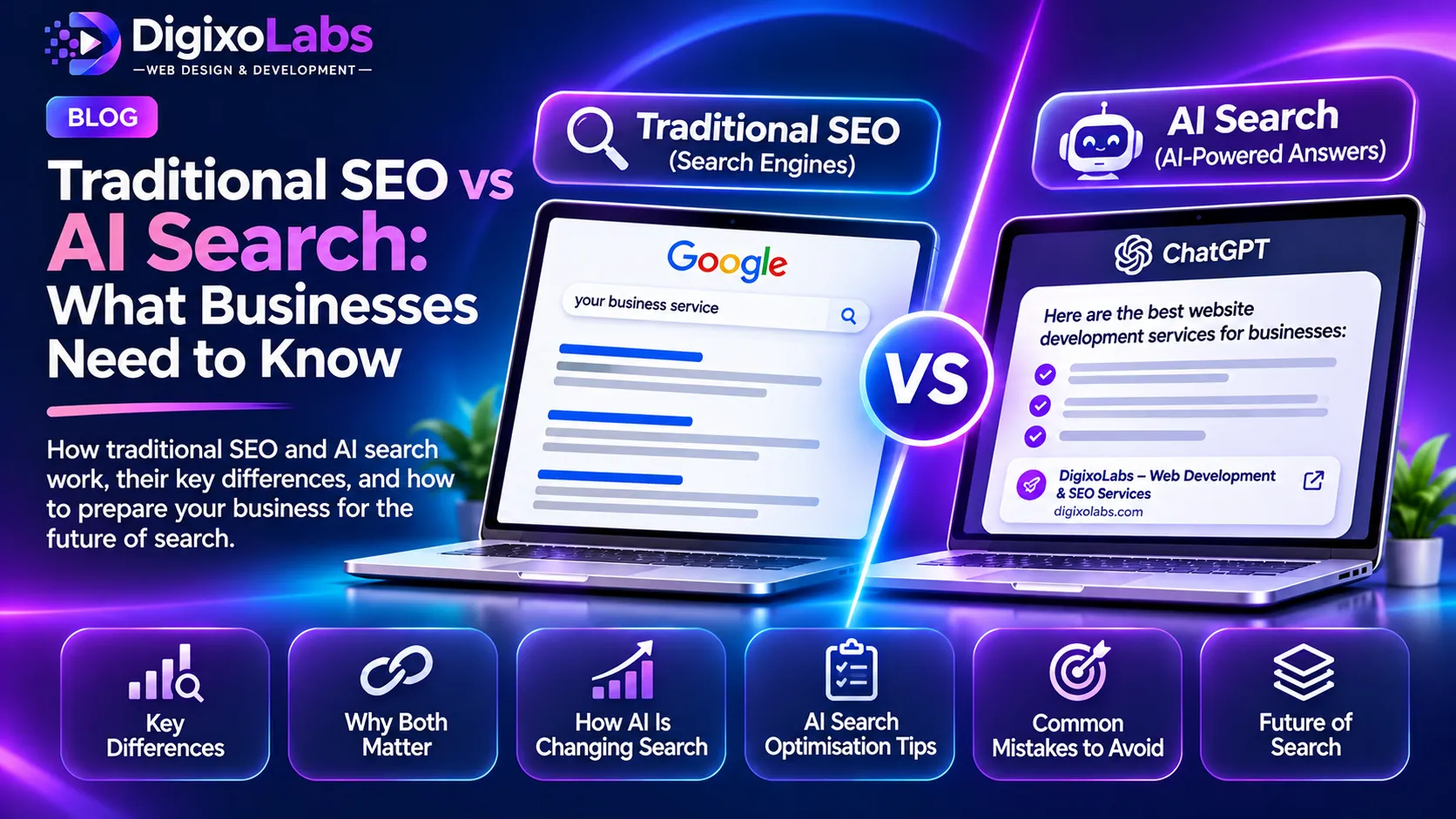
Traditional SEO vs AI Search: What Businesses Need to Know
The way people search for information online is changing. For many years, businesses focused primarily on traditional search engines such as Google and Bing to attract visitors, generate leads and grow their online presence.
Today, people are increasingly using artificial intelligence (AI) tools to find information, compare products, research services and get answers to questions.
Platforms such as ChatGPT, Google AI Overviews, Google AI Mode and Microsoft Copilot are changing how people discover businesses and interact with online content.
This raises an important question for business owners: Is traditional SEO still enough, or should businesses start optimising their websites for AI search?
The answer is that both matter.
Traditional SEO remains an important foundation for online visibility, while AI search introduces new opportunities for businesses to become trusted sources of information.
In this guide, we explain the differences between traditional SEO and AI search, how these technologies work and what businesses can do to prepare their websites for the changing search landscape.
What Is Traditional SEO?
Traditional Search Engine Optimisation (SEO) is the process of improving a website so that it can appear more prominently in search engine results.
When someone searches for a product, service or question on Google, the search engine evaluates different factors to determine which pages are most relevant and useful.
Traditional SEO focuses on improving these factors to help websites gain organic visibility.
Some important traditional SEO activities include:
Keyword research and optimisation
Technical SEO
On-page SEO
Quality content creation
Internal linking
Website speed optimisation
Mobile-friendly website design
Backlink development
Search engine indexing
Local SEO
For example, imagine someone searches for "professional website development company".
A business that has properly optimised its website, created relevant service pages and developed useful content may appear among the organic search results.
Traditional SEO helps businesses attract people who are actively searching for their products or services.
What Is AI Search?
AI search uses artificial intelligence to understand questions, retrieve relevant information and generate conversational answers.
Instead of simply displaying a list of website links, AI-powered search experiences can combine information from multiple sources to provide a summarised response.
Examples of AI-powered search experiences include:
ChatGPT Search
Google AI Overviews
Google AI Mode
Microsoft Copilot
Perplexity AI
For example, instead of searching for "best website maintenance services", someone might ask an AI assistant:
"Which website maintenance services should a small business look for when choosing a provider?"
The AI system may generate a response explaining important maintenance services and, depending on the platform and query, include links to relevant websites.
This creates another opportunity for businesses to become visible to potential customers.
AI search is not limited to short keywords. People can ask detailed questions, describe their requirements and have follow-up conversations to explore different options.
Traditional SEO vs AI Search: Key Differences
Although both approaches help people discover online information, they work differently in how results are presented and how users interact with them.
Here are some important differences.
| Traditional SEO | AI Search |
|---|---|
| Primarily displays ranked search results | Generates conversational answers |
| Often begins with keywords | Often handles detailed questions |
| Focuses on search result visibility | Focuses on relevance within generated responses |
| Users visit websites to compare information | Users may receive summarised information first |
| Rankings are a major measurement | Citations, mentions and visibility also matter |
| Search engine optimisation is the main discipline | SEO fundamentals support AI search visibility |
One important point: AI search does not completely replace traditional search. Many AI-powered search experiences still rely on search indexes, web retrieval and other information sources.
This means traditional SEO continues to play an important role.
How AI Is Changing the Way Customers Search
AI is changing not only where people search but also how they express their requirements.
Let's look at some examples.
1. From Short Keywords to Detailed Questions
Traditional searches often use short phrases such as:
Website development company
Best accounting software
Property management software
SEO services
eCommerce website design
With AI assistants, people may ask more detailed questions:
What should I look for when choosing a website development company?
Which accounting software is suitable for a small business?
What features should property rental management software include?
How can I improve my website's Google rankings?
What is the difference between Shopify and custom eCommerce development?
Businesses should therefore create content that addresses real customer questions, explains services and provides useful information.
2. AI Search Provides More Conversational Experiences
Traditional search generally requires users to open different websites and compare the information themselves.
AI-powered search can summarise information and allow users to ask follow-up questions.
For example, a customer researching an eCommerce platform may ask about pricing, payment integrations, delivery management and scalability in the same conversation.
This creates an opportunity for businesses that publish detailed, accurate and helpful information about their products and services.
3. Website Mentions and Citations Are Becoming Important
In traditional SEO, businesses often measure success through keyword rankings, organic clicks and website traffic.
In AI search, visibility can also come from being mentioned or cited as a source in generated answers.
For example, an AI search experience may reference a company's website when answering a question about a particular service or technology.
However, appearing in an AI-generated response is not guaranteed, even when a website is indexed and technically accessible.
Businesses should focus on building useful content and a trustworthy online presence rather than trying to manipulate AI systems.
Does Traditional SEO Still Matter in the Age of AI?
Absolutely.
One of the biggest misconceptions about AI search is that traditional SEO is becoming unnecessary.
In reality, established SEO practices remain important.
Google explains that its AI search features, including AI Overviews and AI Mode, rely on its existing Search systems. Websites still need to meet normal technical requirements and follow established SEO best practices to be eligible for these experiences.
This means businesses should continue investing in:
Search engine-friendly website structures
High-quality content
Proper keyword research
Technical SEO
Internal linking
Mobile optimisation
Website performance
Relevant backlinks
Accurate and useful information
AI search introduces additional ways for people to discover content, but it does not remove the importance of having a technically sound and useful website.
8 Ways to Optimise Your Website for AI Search
Businesses do not need to abandon traditional SEO to prepare for AI search.
Instead, they should strengthen their existing SEO strategy and create content that is easy for both people and search systems to understand.
Here are eight practical recommendations.
1. Create Helpful and Original Content
High-quality content is one of the most important foundations of both traditional SEO and AI search visibility.
Avoid publishing articles that simply repeat information already available on hundreds of websites.
Instead, create content that provides something useful to your audience.
For example:
Detailed service explanations
Practical industry guides
Original research and insights
Real business examples
Product comparisons
Step-by-step tutorials
Frequently asked questions
If your company offers website development, do not simply publish an article explaining what website development means.
Explain how businesses can choose the right development approach, what features they need and which technical considerations matter.
Original and useful information gives readers a reason to trust your website.
2. Answer Customer Questions Clearly
People increasingly use conversational questions when interacting with AI assistants.
Your website should address the questions potential customers commonly ask.
For example, a property management software company could create content covering:
What is property management software?
How does rental management software work?
Can landlords manage multiple properties online?
What features should a rental management system include?
How can software simplify rent collection?
Use clear headings and provide direct, informative answers.
This makes your content easier to navigate and more useful to readers.
3. Build Strong Topical Authority
Publishing one article about a subject is not always enough to demonstrate expertise.
Businesses should develop useful content around their main services and industries.
For example, a website development company could publish articles about:
Custom website development
PHP and MySQL applications
eCommerce development
Business automation
API integration
B2B web portals
Website security
These related topics help create a stronger content structure.
Use internal links to connect relevant articles with their main service pages.
This helps visitors discover more information and gives search engines additional context about your website.
4. Use Clear Headings and Content Structure
Well-organised content is easier for visitors to read and understand.
It can also help search systems interpret the information on a page.
Follow a logical heading structure:
One clear H1 heading for the main topic
H2 headings for major sections
H3 headings for supporting topics
Use short paragraphs, descriptive subheadings, numbered steps and bullet points where appropriate.
Avoid unnecessarily complicated sentences.
The goal is to make important information easy to find.
5. Demonstrate Expertise and Trustworthiness
Businesses should provide clear information about who they are and what they offer.
A professional website should include:
An informative About Us page
Detailed service descriptions
Accurate business contact information
Company experience and expertise
Relevant case studies
Genuine customer testimonials
Clear policies and business information
For technical subjects, provide accurate explanations and support important claims with reliable sources.
Trust is important for customers and contributes to the overall quality of your online presence.
6. Improve Technical SEO and Website Accessibility
AI-powered search experiences still need to discover and access website content.
If important pages are blocked, inaccessible or difficult to crawl, your website may struggle to gain visibility.
Review the following technical areas:
XML sitemap configuration
Robots.txt settings
Search engine indexing
Canonical URLs
Internal linking
Mobile responsiveness
Page loading speed
HTTPS security
Structured data
JavaScript rendering
Make sure important content is available in readable text rather than being presented only inside images or inaccessible interactive elements.
7. Use Structured Data Correctly
Structured data helps search engines understand specific information on your website.
Depending on your business, relevant Schema.org markup may include:
Organization
LocalBusiness
WebSite
Service
Product
Article
BreadcrumbList
For example, an organisation schema can help describe your company, while article schema can provide information about published content.
Structured data should accurately reflect the visible information on your website.
It is important to understand that adding schema does not guarantee AI citations or appearance in AI-generated answers. Google also confirms that there is no special schema markup required specifically for its AI search features.
8. Keep Your Website Updated
Outdated information can reduce the usefulness and reliability of your website.
Review your existing content regularly.
Update:
Service descriptions
Pricing information
Product details
Technical guides
Industry statistics
Outdated references
Broken links
Company information
For example, an article about SEO strategies published several years ago may contain outdated recommendations.
Reviewing and updating it helps keep the information relevant.
What Is the Difference Between SEO, AEO and GEO?
As AI search becomes more popular, businesses may encounter three related terms: SEO, AEO and GEO.
Understanding the differences helps companies plan their digital marketing strategies.
SEO – Search Engine Optimisation
SEO focuses on improving a website's visibility in traditional search engine results.
Its main activities include keyword optimisation, technical improvements, quality content and link development.
AEO – Answer Engine Optimisation
Answer Engine Optimisation focuses on making content useful and accessible for systems that provide direct answers to user questions.
It encourages businesses to publish clear explanations, answer frequently asked questions and organise information effectively.
GEO – Generative Engine Optimisation
Generative Engine Optimisation focuses on improving the chances of a business or its content being discovered, referenced or cited by generative AI systems.
It involves developing useful, original content, demonstrating expertise and maintaining a technically accessible website.
Although these terms describe different areas of focus, they overlap considerably.
A strong SEO strategy can support AEO and GEO activities. Businesses should be careful of anyone promising guaranteed AI rankings or citations through special optimisation tricks.
How Can Businesses Measure AI Search Visibility?
Measuring AI search performance can be more complicated than tracking traditional keyword rankings.
Businesses should monitor several different indicators.
Traditional SEO Metrics
Continue tracking:
Organic search traffic
Keyword rankings
Search impressions
Click-through rates
Indexed pages
Backlinks
Conversions
Search engine crawl issues
Google Search Console and website analytics tools can help businesses understand their traditional search performance.
AI Search Visibility Metrics
Businesses can also monitor:
Brand mentions in AI-generated answers
Website citations in AI search results
Referral traffic from AI platforms
Enquiries generated by AI-referred visitors
Brand visibility for relevant customer questions
Conversions from AI-assisted discovery
AI responses can vary depending on the query, location, platform and time.
Therefore, checking a single question once is not a reliable way to measure overall visibility.
Use a consistent set of relevant customer questions and monitor results periodically.
Where available, use official reporting tools rather than relying entirely on third-party AI ranking scores.
Common AI SEO Mistakes Businesses Should Avoid
As businesses learn about AI search, some may be tempted to follow shortcuts and unverified optimisation techniques.
Avoid these common mistakes:
1. Publishing Large Amounts of Generic AI Content
Automatically generating hundreds of articles without editorial review can result in repetitive, low-value content.
Focus on originality, accuracy and genuine usefulness.
2. Keyword Stuffing
Repeating the same keywords unnaturally does not make content more valuable.
Write naturally and cover the topic properly.
3. Ignoring Traditional SEO
A website that cannot be crawled, indexed or accessed properly may struggle with both traditional and AI-powered search visibility.
4. Creating Content Only for AI Systems
Your primary audience should always be people.
Write content that genuinely helps customers understand their problems and make better decisions.
5. Believing in Guaranteed AI Rankings
No SEO company can guarantee that ChatGPT, Google AI Overviews or another AI system will mention a particular business.
Be cautious of services promising guaranteed citations or instant AI visibility.
The Future of Search: What Should Businesses Do?
Search technology will continue evolving.
Traditional search engines are introducing more AI-powered features, while independent AI platforms are creating new ways for people to discover information.
For businesses, the best approach is not to choose between traditional SEO and AI search.
Instead, build a website that performs well across both environments.
Start by strengthening your technical SEO, publishing original content, improving your service pages and making your website easy to navigate.
Develop a clear content strategy based on the questions your customers ask.
Make your business information accurate and consistent across relevant online platforms.
Most importantly, focus on building a website that provides genuine value.
Businesses that invest in a strong digital foundation will be better prepared as search experiences continue to evolve.
How DigixoLabs Helps Businesses Improve Online Visibility
At DigixoLabs, we help businesses build and improve their online presence through professional website development, technical optimisation and SEO services.
We understand that modern businesses need more than just a website. They need a digital platform that is technically sound, accessible, informative and ready to support their marketing goals.
Our SEO services focus on important areas such as:
Technical SEO audits
Google Search Console analysis
Website indexing and crawlability
On-page SEO optimisation
Website performance and Core Web Vitals
Keyword research and content planning
Internal linking strategies
Website structure optimisation
Search visibility improvements
Preparation for evolving AI search experiences
Whether you operate a small business website, an eCommerce store or a custom web application, DigixoLabs can help you develop a stronger foundation for online visibility.
Ready to improve your website's search visibility?
Explore our SEO Services:
https://digixolabs.com/seo-services
Frequently Asked Questions (FAQs)
1. What is the main difference between traditional SEO and AI search?
Traditional SEO focuses on improving website visibility in ranked search results. AI search uses artificial intelligence to generate conversational answers and may reference relevant websites as supporting sources.
2. Is traditional SEO still important in 2026?
Yes. Traditional SEO remains important because AI-powered search experiences still rely on many established search technologies and quality signals. Technical SEO, useful content and website accessibility continue to matter.
3. Can ChatGPT recommend my business?
AI platforms may mention or reference businesses when answering relevant questions. However, inclusion depends on the platform, available information, query context and other factors. There is no guaranteed way to make an AI platform recommend a particular business.
4. What is Generative Engine Optimisation (GEO)?
GEO refers to strategies intended to improve the visibility of content and brands in generative AI search experiences. It focuses on useful content, clear information, expertise and discoverability.
5. Do I need a separate website for AI search optimisation?
No. Most businesses can prepare their existing websites by improving technical SEO, content quality, website structure and accessibility.
6. Does adding schema markup help with AI search?
Structured data can help search engines understand website information. However, Google does not require special schema markup for its AI Overviews or AI Mode.
7. How long does it take to improve AI search visibility?
There is no fixed timeline. Results depend on website quality, content relevance, indexing, competition and how different AI platforms retrieve information. Visibility is not guaranteed.
8. Should businesses invest in SEO or AI search optimisation?
Businesses should invest in a combined strategy. Traditional SEO provides the technical and content foundation, while AI search considerations help businesses prepare for changing customer discovery habits.
Final Thoughts
The search landscape is changing, but the importance of a strong online presence has not disappeared.
Traditional SEO continues to help businesses attract organic visitors, while AI search creates additional opportunities for people to discover brands, products and services through conversational experiences.
Businesses should focus on creating useful content, maintaining technically healthy websites, demonstrating expertise and providing accurate information.
Rather than treating traditional SEO and AI search as competing strategies, consider them complementary parts of a modern digital marketing approach.
Build a stronger online presence with DigixoLabs and prepare your business for the future of search.