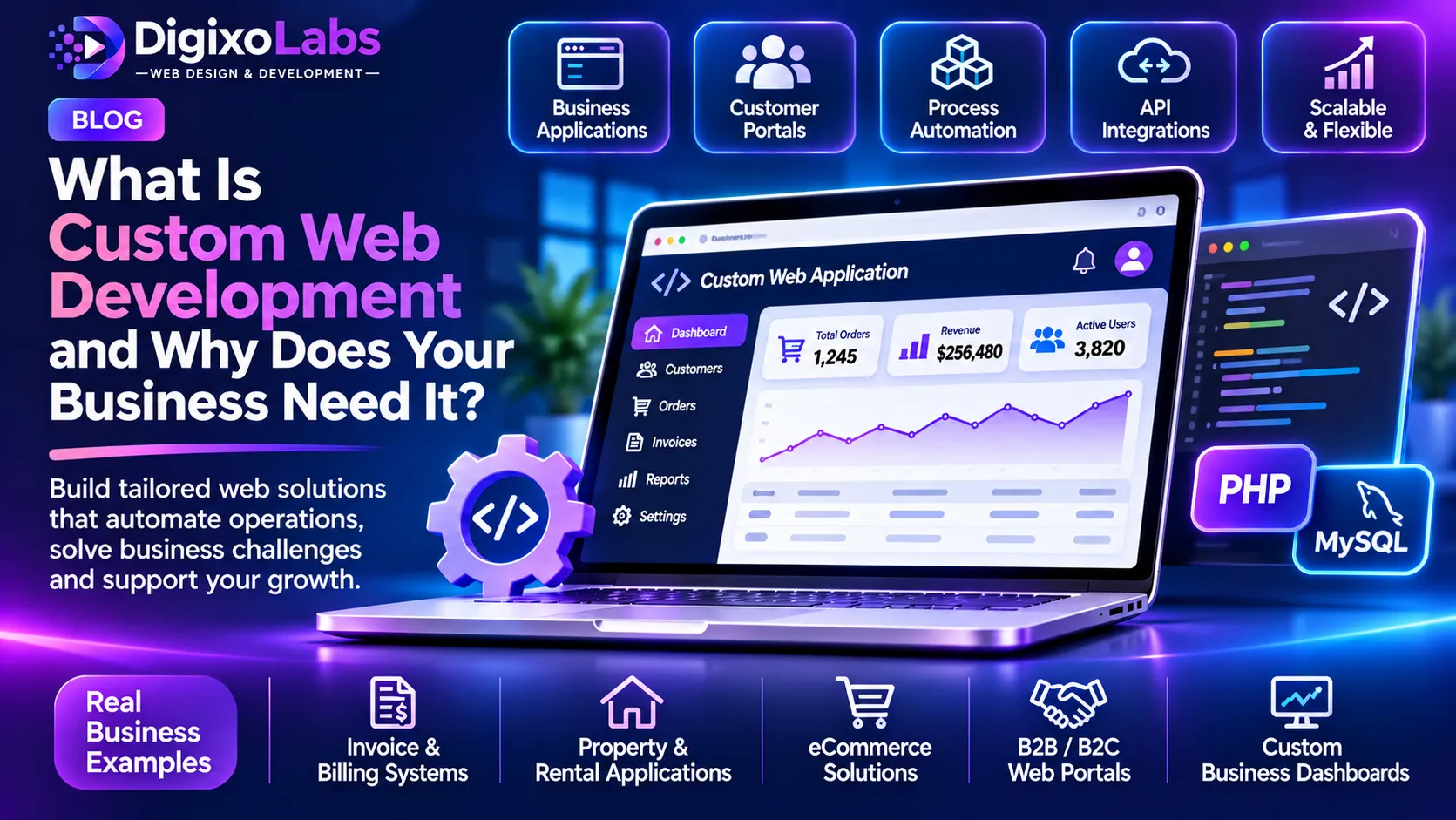
What Is Custom Web Development and Why Does Your Business Need It?
Every business has different requirements, workflows and operational challenges. While ready-made website builders and software platforms can be useful, they do not always provide the flexibility businesses need as they grow.
Some companies need more than a standard website. They need custom dashboards, customer portals, automated business processes, database-driven applications and software that connects different systems.
This is where custom web development becomes valuable.
Custom web development allows businesses to build websites and web applications specifically around their requirements. Instead of adapting business operations to fit an existing platform, companies can develop solutions that work according to their own processes.
Whether you run a small business, an eCommerce company, a distribution business or a large organisation, custom web development can help improve efficiency, automate tasks and create better digital experiences.
In this guide, we explain what custom web development is, how it works, its key benefits and when your business should consider investing in a custom-built solution.
What Is Custom Web Development?
Custom web development is the process of designing and building websites, web applications and online platforms according to specific business requirements.
Unlike ready-made website templates or standard software, custom-developed solutions can be tailored to your company's workflows, features, design preferences and technical needs.
For example, a business may need:
A custom customer management portal.
An online invoice and billing application.
A property rental management system.
A wholesale dealer ordering platform.
An employee management dashboard.
A supplier and vendor management system.
A custom booking and appointment platform.
A business automation application.
These systems can be developed with specific functionality rather than relying entirely on generic software.
Custom web development can involve technologies such as PHP, MySQL, JavaScript, HTML, CSS, APIs and modern development frameworks.
The objective is to build a reliable digital solution that addresses actual business requirements.
Custom Web Development vs Ready-Made Software
Many businesses initially use ready-made platforms because they are convenient and quick to launch.
However, as business operations become more complicated, standard software may not provide everything they need.
Let's compare the two approaches.
| Custom Web Development | Ready-Made Software |
|---|---|
| Built around your requirements | Designed for general users |
| Custom features and workflows | Features depend on the provider |
| Greater control over functionality | Limited customisation in some platforms |
| Can integrate with specific business systems | Depends on available integrations |
| Flexible development roadmap | Bound by the provider's product roadmap |
| Custom database and architecture | Uses the provider's architecture |
| Requires development and maintenance | Maintenance is often handled by the provider |
Neither approach is automatically better for every business.
Ready-made software is suitable when existing features meet your requirements. Custom development becomes attractive when you need more control, specialised functionality or workflows that standard platforms cannot easily support.
10 Benefits of Custom Web Development for Businesses
A custom-developed website or application can provide several advantages when it is designed around genuine business needs.
Here are ten important benefits.
1. Built Around Your Business Requirements
One of the biggest advantages of custom web development is flexibility.
Every business operates differently.
For example, a property management company may need to manage multiple buildings, apartments, tenants, rental agreements, monthly rent and payment records.
A standard website builder is not designed to handle all these processes as a complete business application.
With custom development, you can build specific modules and workflows according to your requirements.
You decide which features are necessary, how users interact with the system and how information is managed.
2. Automate Manual Business Processes
Many businesses still rely on spreadsheets, emails and manual paperwork to manage daily activities.
These processes can consume valuable time and increase the possibility of human error.
Custom web applications can automate repetitive tasks such as:
Generating invoices.
Managing customer enquiries.
Processing online orders.
Sending payment reminders.
Managing appointments.
Updating order statuses.
Generating business reports.
Sending automated notifications.
For example, an invoice application can automatically calculate totals, apply taxes, generate invoice documents and maintain transaction records.
This allows employees to spend less time on repetitive administrative work.
3. Custom Dashboards and User Management
Different people within a business need access to different information.
A custom web application can provide separate dashboards for administrators, employees, customers, suppliers and business partners.
For example:
Administrator Dashboard
Manage users and permissions.
View business activities.
Generate reports.
Configure application settings.
Customer Dashboard
Manage account information.
View invoices.
Track orders.
Submit enquiries.
Employee Dashboard
View assigned tasks.
Update work progress.
Manage customer requests.
Access relevant documents.
Role-based access control helps ensure that users can only access the information and functions they are authorised to use.
4. Better Integration With Other Business Systems
Businesses often use several applications to manage different activities.
For example, an eCommerce company may use separate systems for:
Website management.
Accounting.
Payment processing.
Inventory management.
Customer relationship management.
Shipping and delivery.
A custom-developed application can connect these systems through APIs and other supported integration methods.
This helps information move between applications and reduces the need for repeated manual data entry.
5. Greater Control Over Features and Functionality
With custom software, you are not restricted to the features offered by a general-purpose platform.
You can decide which modules your application should include.
For example, a business portal may start with:
Customer registration.
Login and dashboards.
Enquiry management.
Document management.
Later, you can introduce additional functionality such as:
Automated notifications.
Advanced reporting.
Payment integration.
Third-party API connections.
Multi-branch management.
This makes it possible to develop the application according to changing business needs.
6. Improved Security and Access Control
Business applications often handle sensitive information, including customer records, invoices, financial transactions and company documents.
Custom development allows security requirements to be considered during the development process.
Important security measures can include:
Secure authentication.
Password hashing.
Role-based permissions.
Input validation.
Protection against SQL injection.
CSRF protection.
HTTPS encryption.
Database access controls.
Regular backups.
Security updates.
Security is not guaranteed simply because an application is custom-built. It depends on proper architecture, implementation, testing and ongoing maintenance.
7. Scalable Business Applications
Your business requirements today may be different from those you have in the future.
A well-designed custom application can be expanded as your operations grow.
You may initially need a simple customer portal, but later require multiple departments, additional user roles, advanced reports and third-party integrations.
A properly planned architecture makes these improvements easier to introduce.
Scalability should be considered from the beginning, including database structure, application architecture and hosting requirements.
8. Improved Customer Experience
A well-designed business application can make it easier for customers to interact with your company.
Instead of contacting your staff for every request, customers can access their information through a dedicated online portal.
They may be able to:
Create and manage accounts.
Place orders.
Download invoices.
Track requests.
Book appointments.
Submit support tickets.
Update their details.
Providing these features through an easy-to-use interface can improve customer convenience and reduce unnecessary communication.
9. Ownership and Greater Technical Flexibility
Custom development can give businesses greater control over their software, source code and hosting environment, depending on the development agreement.
This can be useful for companies that want to operate their own applications rather than depend entirely on a third-party software provider.
Before development begins, clarify:
Source code ownership.
Database ownership.
Hosting responsibilities.
Third-party software licences.
Maintenance arrangements.
Future development rights.
Clear agreements help businesses understand what they own and how they can manage their applications.
10. A Long-Term Digital Business Asset
A custom web application can become an important part of your company's operations.
Instead of managing different activities through disconnected tools, you can build a central platform around your business processes.
For example, a wholesale company can use a custom portal to manage dealers, products, orders, invoices and business reports.
A service company can use a custom application to manage customers, appointments, enquiries and project information.
Over time, the application can evolve alongside the business.
Types of Custom Web Applications Businesses Can Develop
Custom web development is not limited to company websites.
It can be used to build many different types of online applications.
Here are some common examples.
1. Business Management Systems
Custom business applications can help companies manage everyday operations through a central dashboard.
Possible features include customer records, employee management, reports, document storage and workflow automation.
2. Invoice and Billing Applications
Businesses can develop custom invoice applications to manage financial documents and billing activities.
Features may include:
Invoice generation.
Quotation management.
Customer records.
Tax calculations.
Payment tracking.
Multi-currency support.
Financial reports.
Tax integration where supported.
3. Property Management Applications
Property owners and property managers can use custom software to manage rental operations.
Features may include:
Property and unit management.
Tenant records.
Rental agreements.
Monthly rent tracking.
Payment records.
Maintenance requests.
Lease document management.
Rental reports.
4. Customer Relationship Management (CRM) Systems
A custom CRM application can help businesses organise customer information and manage sales activities.
Possible features include lead management, customer records, sales pipelines, follow-up reminders and communication history.
5. B2B and B2C Web Portals
Businesses can develop dedicated portals for customers, suppliers, dealers and distributors.
These platforms can support account registration, ordering, document sharing, payment records and business communication.
6. eCommerce Platforms
Companies with specialised selling requirements can build custom eCommerce platforms.
Features may include product catalogues, shopping carts, payment gateways, order management, customer dashboards and delivery integrations.
7. Booking and Appointment Systems
Service businesses can develop booking applications to manage appointments, availability, customer information and automated reminders.
Examples include clinics, consultants, training centres and professional service providers.
8. SaaS Applications
Custom web development can also be used to build Software-as-a-Service (SaaS) platforms.
A SaaS application allows customers to access software through the internet, often using subscription-based pricing.
Examples include invoice software, CRM systems, property management platforms and business automation tools.
What Technologies Are Used in Custom Web Development?
The technologies used depend on the type of application, expected traffic, complexity and hosting requirements.
Some commonly used technologies include:
PHP
PHP is a widely used server-side programming language for building dynamic websites and database-driven web applications.
It can be used for customer portals, administration panels, business applications and SaaS platforms.
MySQL
MySQL is a relational database management system used to store and organise application data.
It is commonly used for customer records, transactions, product information, user accounts and business records.
JavaScript
JavaScript adds interactive functionality to websites and applications.
It can be used for dynamic forms, dashboards, interactive tables, notifications and real-time user interface updates.
HTML and CSS
HTML structures website content, while CSS controls its visual presentation.
Together, they help developers create responsive interfaces that work across desktops, tablets and smartphones.
APIs and Third-Party Integrations
APIs allow different applications to exchange information.
For example, a custom business application may connect with payment gateways, accounting systems, shipping services or messaging platforms.
Choosing the right technology stack is important for application performance, security, maintenance and future development.
How Much Does Custom Web Development Cost?
The cost of custom web development depends on the project's scope and technical complexity.
A simple business website will generally cost less than a database-driven application with multiple dashboards, user permissions, integrations and automated workflows.
Some important factors that influence development costs include:
Number of pages and modules.
Custom design requirements.
Database complexity.
Number of user roles.
Third-party integrations.
Security requirements.
Reporting and analytics.
Hosting infrastructure.
Testing and deployment.
Ongoing maintenance.
Businesses should prepare a clear list of requirements before requesting a development quotation.
A phased development approach can also help manage costs.
Start with essential features, launch the application and introduce additional functionality as the business grows.
When Should Your Business Consider Custom Web Development?
Not every business needs a custom application immediately.
However, there are some situations where custom development may be the right choice.
Consider it when:
Your existing software has limitations: You regularly encounter features or workflow restrictions.
Your team relies heavily on spreadsheets: Important business information is scattered across multiple files.
You repeat the same manual tasks: Employees spend too much time processing routine activities.
You need customer or supplier portals: Your business partners require secure access to information and services.
You need different systems to communicate: Your existing applications do not share information efficiently.
Your business has specialised requirements: Your workflows cannot easily be supported by ready-made software.
You plan to launch a SaaS product: You want to develop and offer your own subscription-based software platform.
If these situations sound familiar, a custom web application may help simplify your business operations.
How to Choose the Right Custom Web Development Company
Choosing a development partner is an important decision.
Your application may become a central part of your business, so the development team should understand both the technical requirements and the business objectives.
Consider the following points before selecting a development company.
1. Review Technical Experience
Look for experience in relevant technologies such as PHP, MySQL, JavaScript, APIs and database-driven application development.
2. Understand the Development Process
Ask how requirements, design, development, testing and deployment will be handled.
A clear development process helps avoid misunderstandings.
3. Review Previous Projects
Examine relevant websites, web applications and business portals developed by the company.
4. Discuss Security
Ask about authentication, user permissions, database security, backups and ongoing updates.
5. Check Scalability
Make sure the development team considers future requirements rather than focusing only on the initial launch.
6. Clarify Support and Maintenance
Understand who will handle updates, bug fixes, hosting issues and future improvements after launch.
A good development partner should help you identify the right solution rather than simply recommending unnecessary features.
Custom Web Development Services by DigixoLabs
At DigixoLabs, we build custom websites, web applications and business platforms designed around specific business requirements.
Our focus is on developing practical digital solutions that help companies streamline operations, improve customer experiences and automate repetitive processes.
Our custom web development services include:
Custom PHP and MySQL applications.
Database-driven web platforms.
Business dashboards and administration panels.
Customer and supplier portals.
SaaS application development.
API development and integrations.
Custom booking and appointment systems.
Business automation solutions.
Custom CRM and management applications.
Responsive website development.
Whether you need a new business application, an existing system redesigned or a specialised online platform developed from scratch, DigixoLabs can help turn your requirements into a working digital solution.
Have a custom web application idea?
Let's discuss your project requirements and explore the right development approach.
Explore our Custom Web Development Services:
https://digixolabs.com/custom-web-development
Frequently Asked Questions (FAQs)
1. What is custom web development?
Custom web development is the process of creating websites and web applications specifically according to a business's requirements. It can include custom functionality, databases, dashboards, integrations and automated workflows.
2. What is the difference between custom web development and website development?
Website development often focuses on building websites that present information, products and services. Custom web development can go further by creating specialised applications, business systems, customer portals and database-driven platforms.
3. Is custom web development suitable for small businesses?
Yes. Small businesses can benefit from custom applications when they have specific requirements that ready-made software cannot meet. Development can begin with essential features and expand over time.
4. Can custom web applications be built using PHP and MySQL?
Yes. PHP and MySQL are commonly used together to develop database-driven web applications, business portals, dashboards and SaaS platforms.
5. Can a custom web application integrate with other software?
Yes. Custom applications can connect with compatible third-party systems through APIs and other integration methods. Examples include payment gateways, accounting software, CRM systems and shipping services.
6. Can custom web applications work on mobile devices?
Yes. Developers can create responsive web applications that adapt to different screen sizes, including desktops, tablets and smartphones.
7. How long does custom web development take?
Development time depends on the application's complexity, number of features, integrations and testing requirements. A simple application may take considerably less time than a large business platform.
8. Is custom web development expensive?
Costs vary depending on the project. A basic custom application may be relatively affordable, while advanced platforms with multiple modules and integrations require more development work. A detailed project assessment helps determine the budget.
9. Can I expand my custom application in the future?
Yes. A properly planned application can be expanded with additional modules, integrations, user roles and reporting features as your business requirements change.
10. Who owns the source code of a custom-developed application?
Source code ownership depends on the development agreement. Businesses should clarify intellectual property rights, source code delivery, third-party licences and ongoing maintenance responsibilities before starting a project.
Conclusion
Custom web development gives businesses the flexibility to build digital solutions around their actual requirements.
From business dashboards and customer portals to invoice applications, CRM systems and complete SaaS platforms, custom development can help automate processes and improve operational efficiency.
While ready-made software is suitable for many standard requirements, businesses with specialised workflows may benefit from a tailored solution.
The right application should solve real problems, support your daily operations and provide room for future growth.
Turn your business ideas into powerful web applications with DigixoLabs.